
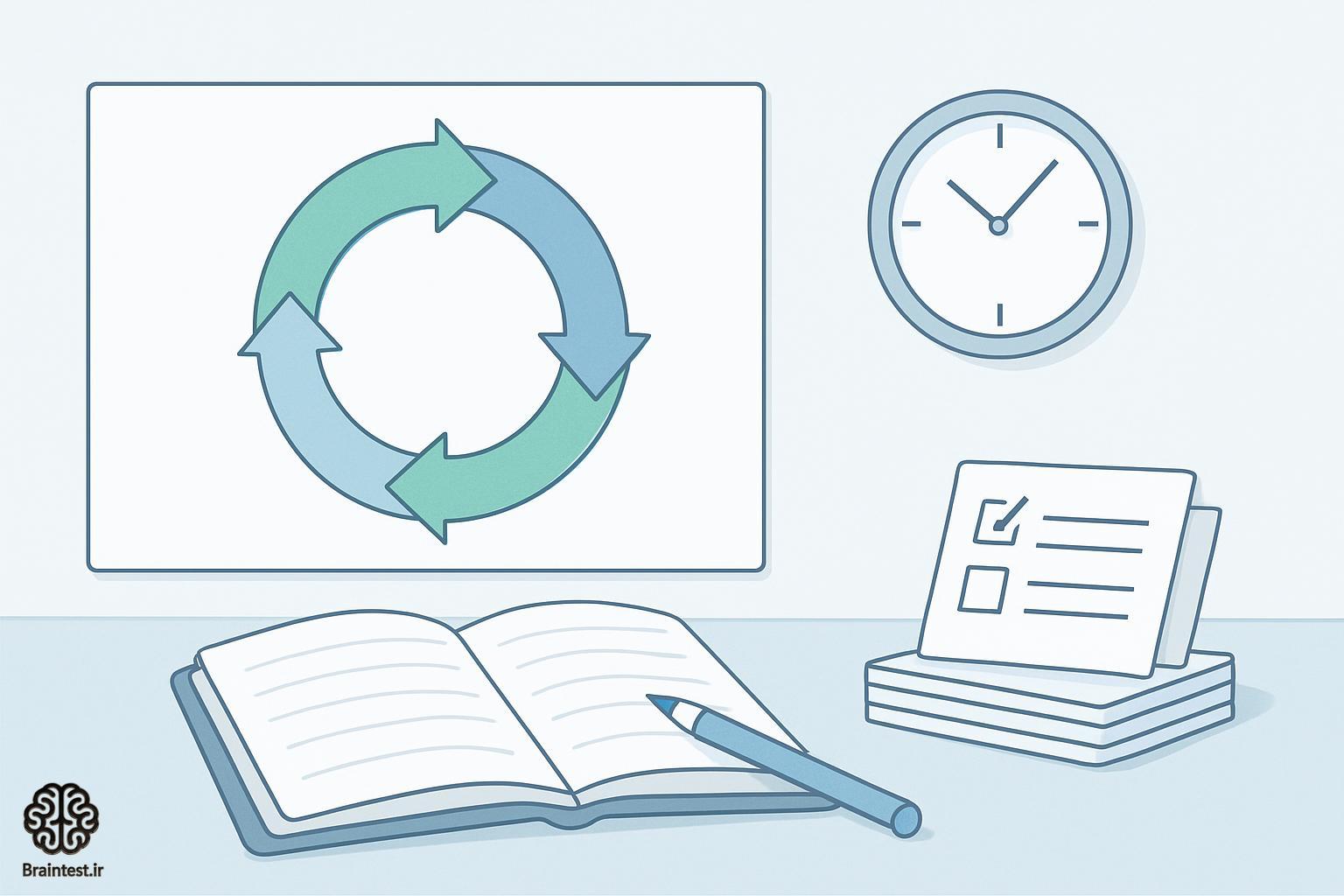
Rumination and the worry cycle usually form when the mind, rather than processing experiences with purpose, gets stuck in a repetitive path and replays the same thoughts with varying intensities. This process often appears, at first glance, like “thinking,” but in practice it does not reduce ambiguity—it reinforces it. The result is increased emotional tension, mental fatigue, and reduced decision-making ability. Understanding why this cycle forms and recognizing ways to break it are an important part of psychological skills for improving quality of life.
What is the difference between rumination and the worry cycle?
Rumination is more focused on repetitive “cause-finding or meaning-making.” For example, the mind may loop again and again on why something happened, who is to blame, or what was wrong in the past. In this situation, thinking resembles analysis, but its output is often not a reduction of the problem; rather, it is repetition of the same issue.
The worry cycle is usually tied to “future-thinking and negative possibilities.” The mind moves through multiple scenarios and tries to predict bad outcomes. Although worry is often perceived as a kind of mental preparation, in practice it can lead to increased chronic anxiety.
Both patterns share one point: repetitive processing without reaching a stable solution. This feature makes the cycle act as a reinforcement of negative emotions instead of solving the problem.
Psychological mechanism: Why does a thought repeat?
The worry cycle and rumination typically draw from several mechanisms at the same time:
1) Negative reinforcement
If, in the short term, anxiety decreases by thinking or a sense of control is created, the brain stores this pattern as a “reward.” Over time, the mind learns to reactivate the same path to reduce discomfort; therefore, the behavior repeats.
2) Attentional bias
When attention becomes locked onto a threatening topic, information related to it is seen more often, while neutral or positive information reaches the mind less. This bias expands the range of repetitive thinking.
3) Cognitive effort to eliminate uncertainty
The human mind tends to want a “definite result.” But many situations remain ambiguous for a while. If the mind tries to remove ambiguity through endless analysis instead of temporarily accepting it, the cycle forms.
4) Conditioning pattern
In some people, environmental triggers (remembering an event, a message, or even an hour of the day) become associated with increased stress levels. Then the brain activates the same thought response to cope—even if that response does not help.
Signs of a repetitive processing cycle in everyday life
Signs may be seen at the mental, physical, and behavioral levels:
- The mind keeps returning to one specific topic, even when focusing on work or conversation might be possible.
- Thoughts may seem logical, but instead of solving the problem, repetition and further review increase.
- Decision-making becomes more difficult because excessive checking takes the place of action.
- Dominant emotions are usually a combination of anxiety, hidden anger, sadness, or shame.
- The body shows signs such as muscle tension, restlessness, sleep disturbances, or fatigue.
The important point is that having these signs does not always mean there is a definite, fixed problem; however, it shows that the processing process is looping instead of moving forward.
How can the repetitive processing cycle be broken? (Practical strategies)
Breaking the cycle is usually not possible with an immediate “stop.” The most effective approaches are based on changing the direction of processing, reducing the fuel that feeds it, and replacing repetitive patterns with purposeful behaviors.
1) Cognitive labeling without getting caught in it
When repetitive thoughts rise, using a short label such as “rumination” or “worry” can create mental distance. The goal is not to make the thought disappear; the goal is to turn the thought from a “absolute reality” state into a “mental event.” This shift in perspective reduces the intensity of the cycle.
2) Shift from analysis to action
In the worry cycle, analysis often becomes endless. Therefore, a practical criterion can be used: if a specific solution for taking action is available, the relevant part should be carried out in practice; if no definitive solution exists, instead of continuing to review, choose a small, limited next step. A small action transfers psychological energy from “thinking about the problem” to “moving toward solving it.”
3) Limiting the time spent on rumination and worry
One common technique for controlling the cycle is “thought scheduling.” In this method, a short time window is set aside to address the topic. Outside that window, the thoughts are referred back to the scheduled time. This prevents thought from expanding without limits and tells the brain that the cycle can be managed—not completely eliminated.
4) Cognitive state-shifting technique: from “Why did it happen?” to “What might be possible now?”
In rumination, the dominant mental sentences often begin with “Why did it happen?” or “If it hadn’t been that way…” Gradually shifting to practical questions without direct confrontation changes the path. For example, instead of searching for exhausting causes, the focus becomes “possible actions in the present moment.” This shift helps move from past-focused thinking to actionable future-focused thinking.
5) Regulating attention through bodily focus
The mental loop is often accompanied by physical tension. Short breathing exercises or muscle relaxation can reduce the intensity of arousal. The goal of this approach is not to completely switch off thought, but to create the possibility of less impulsive thinking.
6) Using recording and review
Recording repetitive thoughts in an organized format helps the mind move out of automatic mode. A practical structure includes the following:- the topic of the repetitive thought- the dominant accompanying emotion (e.g., anxiety, sadness, anger)- mental evidence for and against- the real outcome in practice (not merely a hypothetical outcome)- the next small step or a specific decision
This review turns the thought from a “general verdict” into “a testable hypothesis.”
7) Training cognitive flexibility
In cycles of worry and rumination, the mind often works with extreme certainties: “Certainly,” “Never,” “The worst-case scenario.” Cognitive flexibility training means reducing absolutism and replacing it with more realistic probabilities. This does not mean ignoring worry; rather, it can prevent worry from turning into a fixed, definite judgment.
8) Managing triggers and underlying conditions
Sleep quality, caffeine intake, lack of physical activity, and work pressure strengthen the conditions that feed repetitive thinking. Planning for regular sleep, reducing intensifying triggers, and adding short, meaningful activities often has a noticeable effect on the cycle. This approach goes beyond purely cognitive therapies and helps regulate lifestyle habits.
The role of acceptance and distancing from thought
Acceptance does not mean surrendering; it means reducing conflict with the thought itself. When a repetitive thought is met with an attempt to immediately destroy it, the mind highlights it even more. Psychological distancing means observing the thought as a mental event, not as a definite guide to reality. This distance allows the person’s psychological energy to be redirected toward valuable activities or practical action.
When does professional help become necessary?
In most cases, using self-help strategies and cognitive skills can reduce the cycle. However, if the intensity of repetitive thoughts is very high, everyday functioning is disrupted, or sleep and physical health problems continue seriously, a professional evaluation can offer a safer path for management. Also, if obsessive thoughts or repetitive behaviors become a major barrier to life, closer examination is important.
Summary
The worry and rumination cycle persists when, instead of purposeful processing, the mind becomes trapped in a reinforcing repetitive path. The most effective way to break this cycle is not complete elimination of the thought; rather, it is changing the thought’s position, limiting its time and intensity, shifting from endless analysis to small, doable actions, regulating attention through bodily strategies, and using structured recording of thoughts. By implementing a combination of these strategies, repetitive processing moves out of automatic mode and the path becomes clearer toward reducing tension, increasing mental flexibility, and achieving more stable, improved decision-making.