
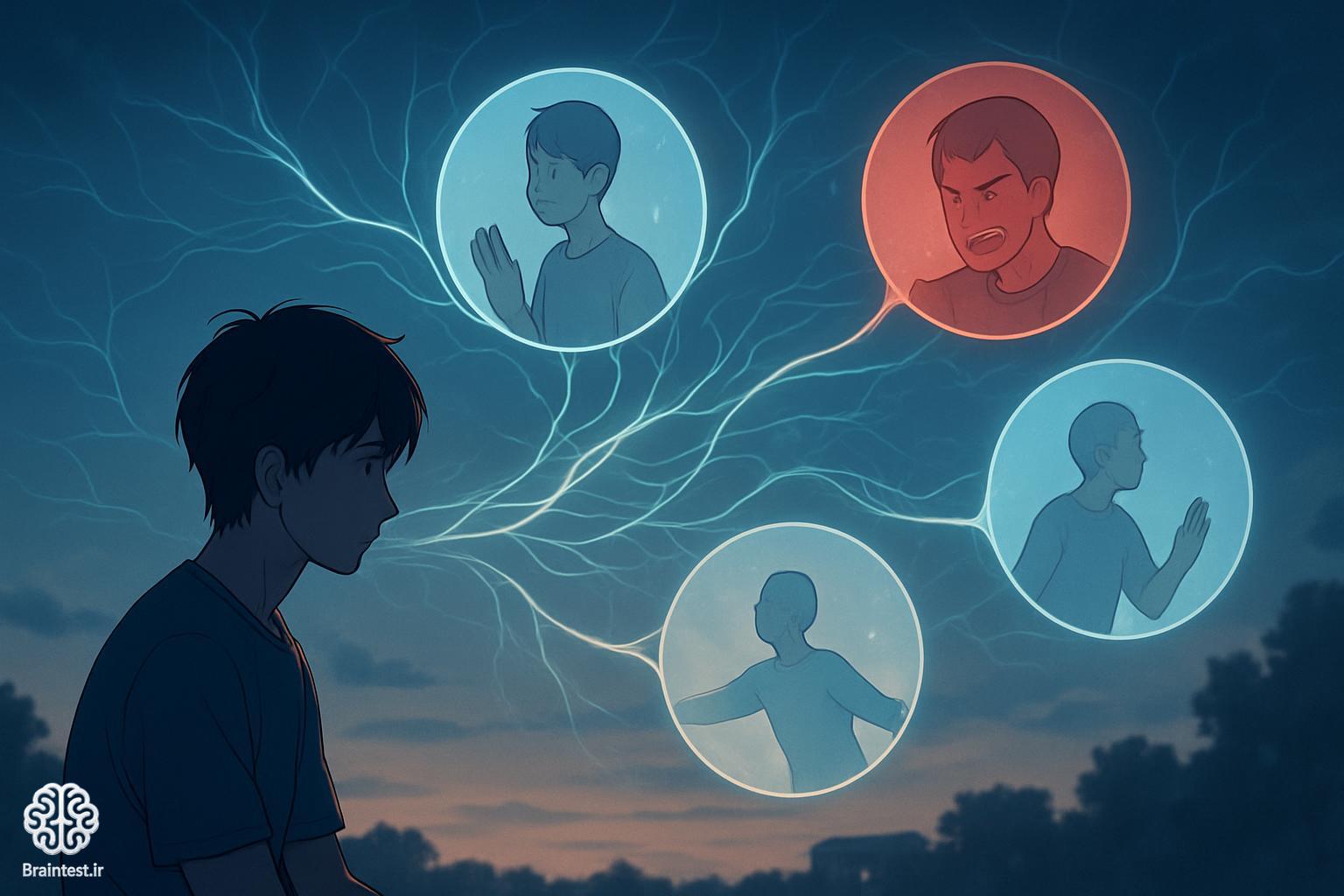
Automatic Thoughts: How Unconscious Thoughts Influence Feelings and Behavior
In many everyday situations, emotional and behavioral reactions form before the mind has time to find a precise explanation. An important part of this phenomenon relates to “automatic thoughts”—thought patterns and rapid appraisals that determine how events are interpreted without full awareness. These thoughts can work in a useful way—such as recognizing danger or making quick decisions in repeated situations—and they can also, when inaccurate or inconsistent, distort the intensity and direction of emotions and push behavior along an unhelpful path.
What Are Automatic Thoughts, and Why Do They Form?
Automatic thoughts refer to fast, low-effort mental processes that are often outside conscious control. These processes usually involve a few short steps: noticing a cue, activating an old pattern, making a quick interpretation, and finally generating the corresponding emotion and behavior based on that interpretation.
The roots of these patterns often lie in a combination of learning from past experiences, mental habits, and the influence of the social environment. As the brain develops, repeated exposure to similar patterns makes processing pathways simpler and more automatic. Therefore, when a stimulus appears again, the same ready-made pathways are activated—even if a new interpretation and different evidence are available.
The Role of Cognitive Psychology: From Stimulus to Response
In cognitive psychology, interpretive and evaluative processes are of special importance. Automatic thoughts typically function as “instant appraisals”: the event itself is not received as neutral; instead, a meaning is assigned immediately. This quick meaning-making can lead to dominant emotions and impulsive behaviors.
For example, in a group setting, a brief pause in someone’s response may occur. An automatic thought might interpret it as a sign of “disregard” or “rejection.” The result usually doesn’t remain only as a thought; the body becomes involved at the same time: physical tension, heightened sensitivity, and activation of protective behaviors such as withdrawing or becoming overly talkative to make up for it.
In many cases, the person does not consciously realize what the initial interpretation was. What is visible is the intensity of the emotion and the type of reaction. Automatic thoughts are often the hidden factor behind this chain.
How Do Automatic Thoughts Guide Emotions?
Emotions are not limited to an internal experience; emotions, in practice, are the product of mental interpretations. Automatic thoughts can create different emotions by determining the “meaning” of an event. As a result, two people may experience the same situation, but their psychological outcomes can be completely different.
1) Rapid activation of threat or value meaning
If a cue is interpreted as a threat, emotions such as anxiety, anger, or fear become activated. If the cue is interpreted as an opportunity or safety, emotions such as calmness or motivation take shape.
2) Sustaining emotion through mental repetition
Automatic thoughts do not occur only for a moment; they often maintain the intensity of emotion through repetition in the mind. Even when new information exists, the brain may cling to the previous interpretation and rebuild it.
3) Simultaneity of bodily and mental responses
Automatic thoughts are usually accompanied by bodily changes. Increased heart rate, muscle tension, or changes in breathing patterns can also strengthen the emotional experience itself. In the process, the body becomes an amplifier of the mental interpretation.
The Role of Social Psychology: Automatic Thoughts in the Form of Stereotypes and Attributions
The social environment provides a powerful context for the formation of automatic thoughts. Norms, stereotypes, communication patterns, and even media messages can create rapid mental templates that become activated in real interactions.
Stereotypes and instant attributions
In social psychology, “attribution” refers to assigning the cause or meaning of a behavior to a person’s traits or to the situation. Automatic thoughts can cause attributions to happen in the moment. For example, a neutral behavior may be attributed to traits such as “irresponsibility,” “lack of interest,” or “ill intent.” The faster the attribution and the less it can be checked, the more likely conflict in relationships increases.
Automatization of interaction rules
Many reactions in social interactions are stored as implicit rules: “If someone pauses, you must respond quickly,” “If there is disagreement, it means rejection,” “If you’re not praised, it means there’s no value.” These rules may look simple on the surface, but their effects can be far-reaching: from how a conversation is started to the kind of defense or yielding to social pressure.
Personality Psychology: Differences in the Content of Automatic Thoughts
Automatic thoughts are not the same in everyone. Their content can relate to personality traits, attachment styles, and stable patterns of information processing. Some people are more prone to activating thoughts related to threat, while others move more along thoughts related to failure or worthlessness.
These differences do not mean there is an absolute judgment; they show that psychological mechanisms for interpreting the world have been organized according to one’s developmental history and learning. The practical outcome of these differences is that similar stimuli may create different meanings in different people.
Developmental Psychology: The Formation of Automatic Thoughts From Childhood to Adulthood
Automatic thoughts often form along the path of development. Early experiences—especially the response patterns of those around them, the quality of relationships, and the stability of the environment—can be stored in the form of implicit beliefs and “unwritten rules.”
In childhood, the brain creates strategies for predicting outcomes. If in the past others’ reactions were predictable, processing pathways may work more realistically. But if the environment was unstable, the mind likely learns to anticipate danger or rejection in advance. Over time, these expectations turn into automatic thoughts—thoughts that can be activated even by small cues in adulthood.
Clinical Psychology: Why Do Some Automatic Thoughts Lead to Maladaptive Cycles?
In clinical settings, automatic thoughts are discussed as part of stable cycles in anxiety, depression, obsessive-compulsive disorder (thought-action), and chronic patterns of interpersonal conflict. It is important to note that automatic thoughts are not, by themselves, a diagnosis, but they can play an amplifying role in the persistence of problems.
Repetitive cycles
In a common pattern, the sequence is: event → automatic interpretation → intense emotion → behavior or avoidance → temporary reduction of distress or worsening consequences. If avoidance behavior leads to short-term reduction in anxiety, the likelihood of repeating it increases; but in the long run, the opportunity to correct the initial interpretation decreases, and the cycle becomes more entrenched.
Cognitive biases aligned with automatic thoughts
Automatic thoughts often align with biases such as filtering out positive information, exaggerating the probability of negative events, or generalizing based on limited evidence. This alignment causes the mind to pay less attention to contrary data and to hold the initial interpretation more firmly.
The role of emotional patterns
In many psychological problems, the main issue is not “not being able to feel,” but the quality of interpretation and meaning-making. Automatic thoughts can link emotions to catastrophic outcomes or old conflicts, increasing the intensity of the experience.
How Do Automatic Thoughts Shape Behavior?
Behavior is usually not a direct result of a thought; rather, automatic thoughts activate pre-made pathways for action. These pathways can include communicative choices, avoiding situations, or aggressive/defensive responses.
Avoidant behaviors
When an automatic interpretation gets tied to threat or failure, a person may avoid encountering similar situations. Avoidance often reduces anxiety in the short term, but in the long term it reinforces the initial belief that “confrontation is dangerous or impossible.”
Compensatory behaviors
In response to beliefs related to worthlessness or deficiency, compensatory behaviors may appear: over-pursuing reassurance, being controlling, or doing tasks intended to neutralize negative evaluation. These behaviors may provide temporary relief, but they also create the conditions for the persistence of automatic thoughts.
Impulsive reactions in relationships
When an automatic thought is tied to “rejection” or “disrespect,” the reaction may be quick and without careful review: cutting off the conversation, escalating the argument, or going cold. Its effect is usually damage to the relationship and an increased likelihood of the same initial cues occurring again, thereby reinforcing the cycle.
Common Signs of Automatic Thoughts Being Activated
For most people, identifying the content is not that simple, but the signs of activation can be observed. Some indicators include:
- Rapid changes in emotional state after a brief cue
- Repeating a specific sentence or theme in the mind (even without conscious prompting)
- A tendency to make a single-cause interpretation of an event (e.g., attributing everything to one reason)
- Difficulty considering alternative explanations
- Preference for predictable, repetitive behaviors in similar situations
These signs are not diagnoses on their own; rather, they represent the activation of a rapid mental pattern.
Why Is Changing Automatic Thoughts Not Always Easy?
Automatic thoughts are “low-cost” and fast. This very feature makes them activate by default, and it can be difficult for the mind to stop them in the moment. In addition, every functional mental pattern serves a purpose: reducing uncertainty, protecting emotionally, or trying to manage the future. Even maladaptive thoughts usually serve some form of psychological protection, even if their output harms relationships and quality of life.
That is why change usually requires time, repetition of practice, and building new pathways for interpretation—not just momentary awareness.
Summary
Automatic thoughts are unconscious thoughts and rapid appraisals that form from experience and learning, and that become activated when everyday cues appear. These thoughts determine the meaning of an event before conscious evaluation, then guide emotions, and subsequently shape behavior. At the level of social psychology, automatic thoughts can reinforce stereotypes and instant attributions; at the level of developmental psychology, early experiences turn into implicit rules; and in cognitive psychology, perceptual biases make them even more firmly established. Within clinical psychology as well, these quick patterns can persist in maladaptive cycles, increasing the severity and stability of psychological problems. The final takeaway is clear: changes in quality of life depend, to a large extent, on how quickly and automatically we interpret things; and understanding these mechanisms is the first step toward reducing their harmful effects and strengthening more adaptive responses.